Vibecoding Is the New Product Management
The job description hasn't changed. The job has.
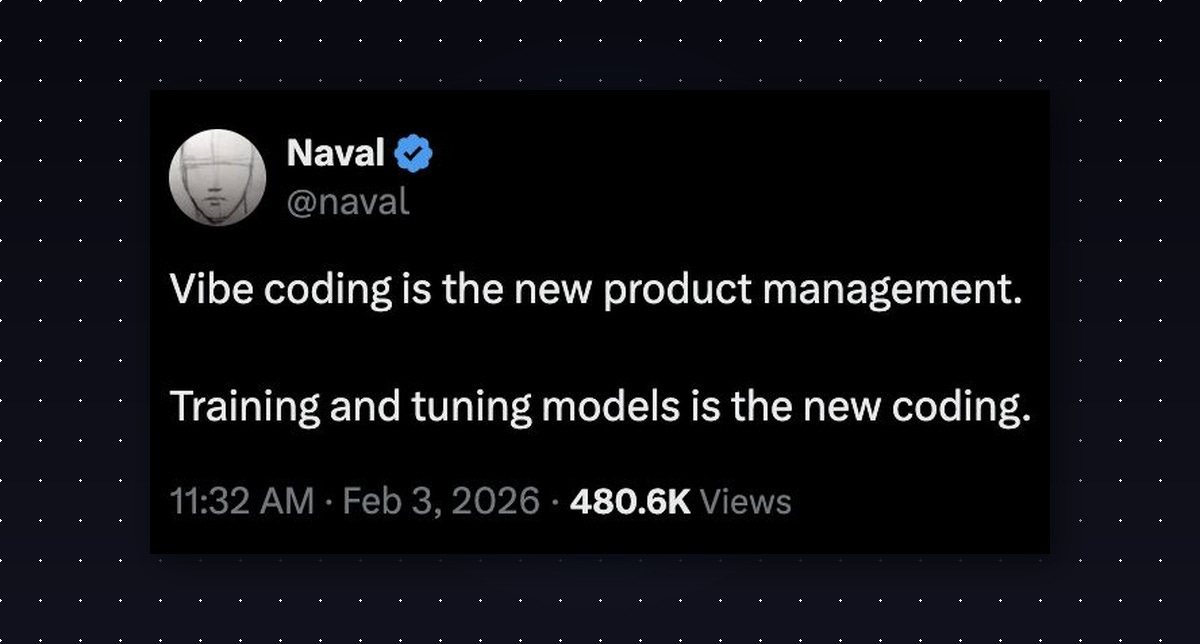
The job description hasn't changed. The job has.
Let me say something that will make some engineers uncomfortable and most PMs quietly excited:
You were always the one who should have been building.
The Origin of a Paradigm Shift
On February 2, 2025, Andrej Karpathy, former Senior Director of AI at Tesla and OpenAI co-founder, published a tweet that got over 4.5 million views. He introduced a term: "vibe coding."
"There's a new kind of coding I call 'vibe coding', where you fully give in to the vibes, embrace exponentials, and forget that the code even exists." Andrej Karpathy, X, February 2025
Most people read this as a story about developers. I read it as a story about product managers.
Because what Karpathy described: telling a system what you want in plain language, iterating rapidly, focusing on outcomes rather than implementation, isn't a new programming style. It's the literal job description of a PM.
The Wall That Was Never Ours to Begin With
For decades, product management has operated with a structural handicap: the PM who has the vision cannot build, and the engineer who can build doesn't always share the vision. Every PRD, every sprint planning, every "can we get this done by Q3?" conversation exists because of this gap.
We dressed it up in frameworks: user stories, roadmaps, acceptance criteria. All of it, at its core, was a translation layer between a human with a product intuition and a system that needed explicit instructions.
Here's the uncomfortable truth: that translation layer was never solving the real problem. It was compensating for a tooling limitation that no longer exists.
According to a 2024 GitLab survey, 78% of development teams already use AI-assisted coding. By 2027, 80% of developers will require AI skills. The wall between "thinking about a product" and "building a product" is collapsing, and PMs are standing on exactly the right side of the rubble.
Why PMs Are the Natural-Born Vibecoders
Here's what nobody in the "vibecoding for developers" conversation is saying loudly enough: the skills that make someone a great PM are identical to the skills that make someone great at vibecoding.
Consider what vibecoding actually demands:
- Clarity of intent: knowing what you want to build before you say it
- User-outcome thinking: evaluating output by behavior, not by code quality
- Rapid iteration: treating the first version as a learning artifact, not a deliverable
- Constraint awareness: understanding what's feasible before going deep
Jackie Bavaro, author of Cracking the PM Interview, put it directly: "Vibe coding is a dream come true for product managers: all the skills we've built up working with engineers and designers are exactly what you need to work with an AI teammate."
The irony is sharp. We spent years asking PMs to "learn to code" to be more effective. It turns out we were giving them the wrong homework. The real superpower was always product intuition, and vibecoding finally lets that intuition ship.
From Bottleneck to Velocity Machine
Think about how a traditional PM operates when they have a new idea for a feature:
- Write a brief
- Get design bandwidth (maybe in 3 weeks)
- Get engineering to scope it (another week, or never)
- Ship an MVP that vaguely resembles the original vision
- Discover the real insight only after users interact with it
Now consider what the Pendo team calls the "Vibe PM": a product manager who starts working on an idea before it's fully baked, prompting an AI to explore the design space, generating a functional prototype in an afternoon, and showing real users a real thing. Not a Figma file with fake data.
This isn't just faster. It's epistemically different. You discover what you don't know about your own product idea by building it, not by writing about it.
A senior PM at Observe Inc. described spending a few afternoons vibe coding with Claude Code to build automations that saved his team hours weekly, connecting Salesforce, Gong, JIRA, and Notion in ways that would have taken months through traditional engineering cycles. His conclusion was telling: what I learned about vibe coding turned out to be more valuable than the time saved.
He wasn't learning to code. He was learning to manage an AI system the way he already managed human collaborators: with clear goals, explicit expectations, and accountability loops.
The Role Transformation Nobody Is Saying Out Loud
Let's be precise about what's actually changing.
Vibecoding doesn't make PMs into engineers. It makes PMs into builders of working hypotheses. The distinction matters enormously.
An engineer's job is to write code that is correct, maintainable, scalable, and secure. Those constraints exist for very good reasons and don't disappear in the age of AI.
A PM's job is to find the right thing to build as fast as possible, get it in front of real users, and generate signal. Those goals are now achievable without writing a single line of code, or waiting for a sprint.
As Product People documented, vibecoding gives PMs three structural advantages: speed for discovery, independence for internal tooling, and the ability to stay current with the technological surface area of their own product. Each of these used to require either technical skill or political capital. Now they require clarity of thought and a decent prompt.
And this is where product intuition becomes a superpower, not just a soft skill.
A PM who deeply understands users, who has internalized what "good" looks like, who can feel when a flow is wrong before they can explain why: that PM, armed with vibecoding tools, is running circles around teams that still route every idea through a six-week backlog.
What This Means for Product People in 2025 and Beyond
The product managers who will matter in the next five years aren't the ones with the best prioritization frameworks or the most polished roadmaps. They're the ones who can close the loop between intuition and validation the fastest.
Vibecoding is the mechanism. Product intuition is the fuel. The combination is something the industry hasn't seen before: a PM who can build a working test of their hypothesis before standup.
The ACM's analysis of the vibecoding imperative identifies the new PM skill stack clearly: AI literacy, prompt engineering expertise, data fluency, and human-AI orchestration. Notice what's on that list. None of it is "learn React." All of it is learn to direct intelligent systems toward user outcomes, which is, again, the job.
Karpathy said the hottest new programming language is English. For product managers, English was always the only language we had. We just didn't know it was enough.
A Provocation to Close
If you're a product manager reading this and you haven't shipped a vibecoded prototype yet, you're not "waiting for the right moment." You're falling behind.
The engineers who embraced vibecoding didn't wait for permission. They shipped. They learned. They iterated.
Product management has always been the discipline of making things happen without direct control. Vibecoding is just the first time the tools caught up to the role.
Go build something ugly. Show it to a user tomorrow. That's the new PM workflow.

Written by
AI product engineer. Computer engineer by training, five years in product; 10+ products shipped across B2B SaaS, FinTech, Crypto and AI.