Taste Is the Last Moat
When execution is free, judgment is the only edge left.
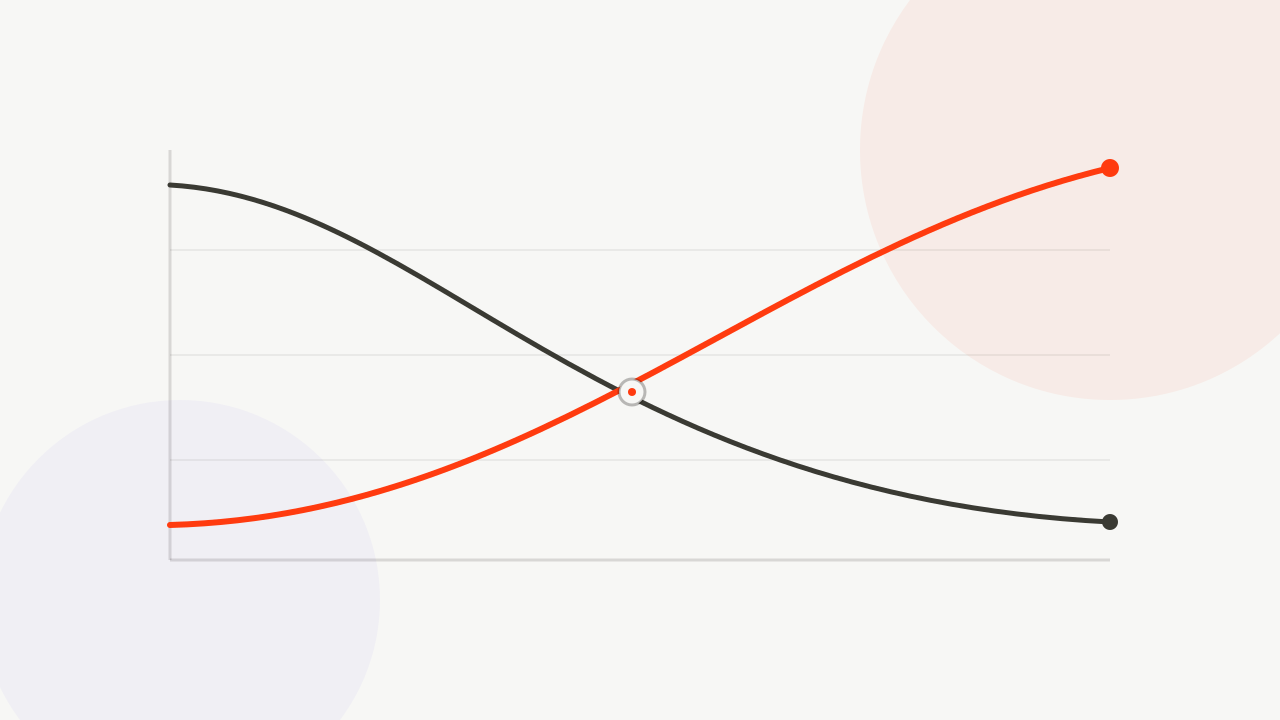
When anyone can build anything, the scarce part is knowing what's worth building.
For most of software's history, the hard part was making the thing. The idea was cheap; the build was expensive. A feature meant a spec, a team, a quarter, a fight. So we optimized the whole industry around the bottleneck: prioritization frameworks, roadmaps, sprint math. All of it was elaborate machinery for rationing a scarce resource called engineering time.
That resource just stopped being scarce. As an AI-native PM, I can go from a sentence to a working prototype before lunch. The cost to build didn't shrink. It fell off a cliff. And when a cost collapses, value rushes somewhere else, mostly into taste.
The floor fell out
I ship things solo now that used to need a team and a quarter. I'm not special; the wall between thinking about a product and having the product is simply gone. Anyone with a clear head and a decent prompt gets the same superpower.
People celebrate that part. The part they skip: if everyone can build, building is no longer where you win. A capability everyone has is table stakes, not an advantage.
Everyone can ship. Almost no one can choose.
Walk through any app store, any timeline, any launch feed today. It's drowning in competent, generic, AI-shaped products, each one technically fine, most of them pointless. Abundance didn't raise the average. It buried it.
When building was expensive, scarcity did your filtering for you. You couldn't ship everything, so you were forced to choose, and the cost of building was itself a kind of quality gate. Remove the gate and you get infinite output and zero selection. The bottleneck didn't disappear. It moved from "can we build it?" to "should we, and is this the right version of it?"
That second question was always the actual job. We just never had to answer it under this much pressure, because reality answered a lot of it for us. Now it doesn't.
Taste is compressed judgment
I'll push back on the word itself. "Taste" gets used like a gate, an innate gift you either have or don't, usually invoked to keep people out. Convenient nonsense.
Taste is compressed judgment: thousands of small decisions about what's good, absorbed, pattern-matched, and fired so fast it feels like intuition. A strong PM senses a flow is wrong before they can explain why. That "feel" comes from a model trained on reps, not magic. It isn't mystical and it isn't fixed. Think of it as a muscle. Like any muscle, it grows from load, not from theory.
That reframe matters, because in a world where the machine handles execution, the human's entire contribution collapses into that trained sense of this over that.
Curation is the new core skill
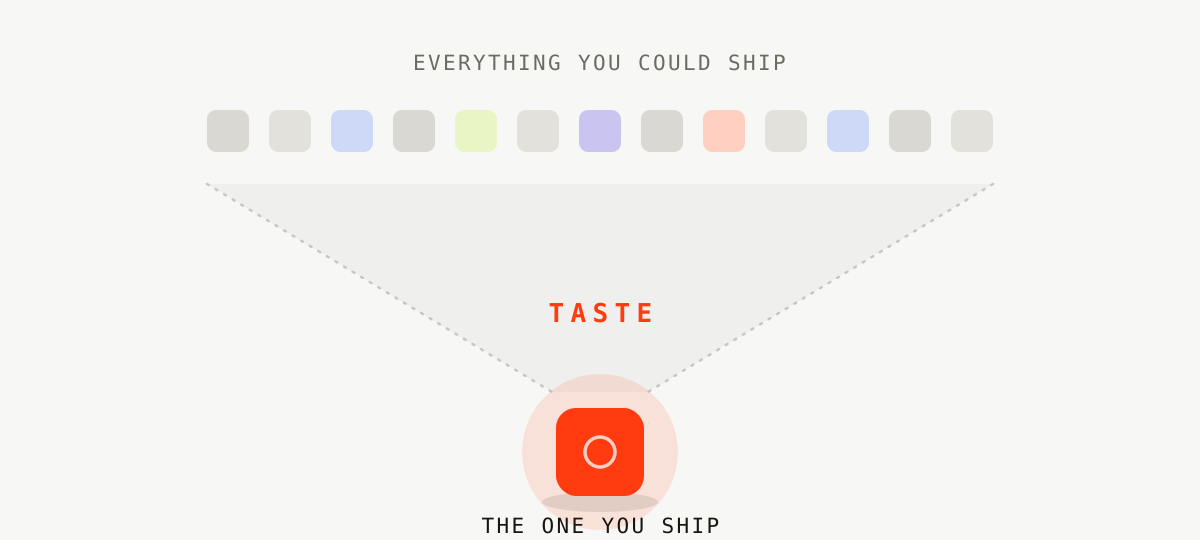
The PM job is inverting. It used to be: generate specs, push them through a scarce build pipeline. Now generation is free and infinite. You can have ten versions of anything by dinner. So the work stops being production and becomes editing. Killing nine of the ten. Saying no, at volume, with a reason.
The best product people I know now look less like planners and more like editors: a sharp point of view about what belongs, and a sharper one about what doesn't. When output is infinite, the person who can cut is worth more than the person who can produce, because everyone can produce now, and almost no one has the nerve to cut.
Curation used to feel like the soft part of the job. For a lot of product work now, it is the job.
How to build taste on purpose
If taste is learnable, then it's trainable. This is roughly how I've tried to train mine:
- Ship a lot. Volume first. You cannot develop judgment about work you never make. Reps beat theory, every time, and the fastest way to calibrate taste is to be wrong in public and notice.
- Take the good stuff apart. When a product feels right, don't just admire it. Name why. What did they cut? What did they refuse to add? Reverse-engineer the decisions, not the pixels.
- Keep the feedback loop tight. Put the thing in front of real users fast and let reality correct your model. Taste calibrated only against your own opinion quietly drifts into self-indulgence.
- Develop a point of view. Taste without conviction is just imitation with better references. Decide what you stand for and let it cost you. The right people lean in precisely because some people bounce.
- Curate your inputs. Your taste is downstream of what you consume. Feed it deliberately; a mind fed on average work produces average judgment.
None of this is fast. That's fine. It may be the one thing that doesn't compress into a prompt.
The moat
Models are a commodity. Everyone rents the same intelligence at the same API. The prompt is a text box, not a moat. The build is an afternoon, not a moat. Strip all of that away and ask what's actually left to defend, and the answer is uncomfortable in how small and how human it is: the judgment pointing all that capability at the right thing.
The tools will keep getting better at building. They will not get better at caring, at choosing, at knowing when something is right rather than merely done. That discernment is the last thing left that compounds, and unlike a model, nobody can spin up a copy of yours overnight.
Taste may be the last real moat left. Treat it like the only one you've got. Increasingly, it is.

Written by
AI product engineer. Computer engineer by training, five years in product; 10+ products shipped across B2B SaaS, FinTech, Crypto and AI.