The Turk Inside AI
Hundreds of millions of people keep AI running, and their invisibility is not an accident but a design. Türkiye does not even know where it sits on this map.
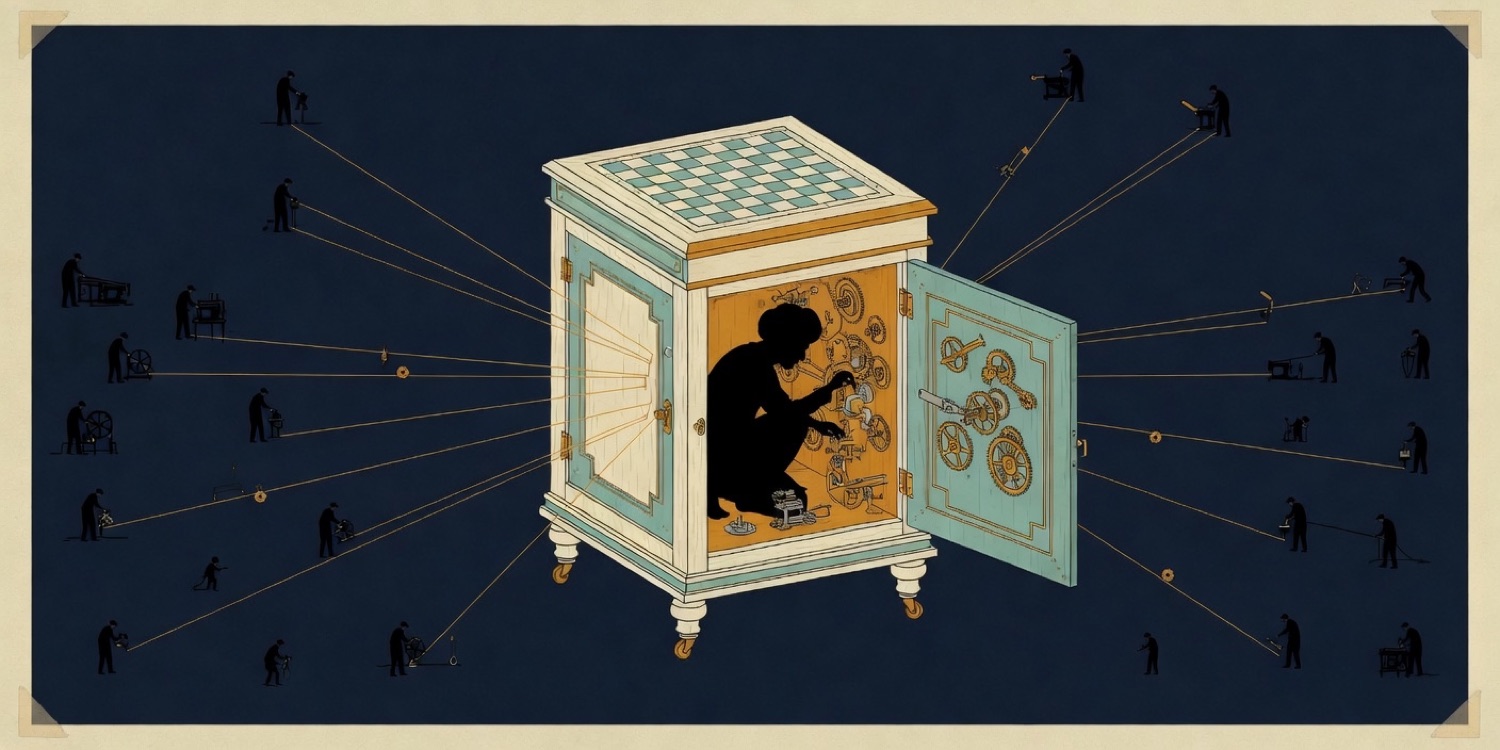
Hundreds of millions of people keep AI running, and their invisibility is not an accident but a design. Türkiye does not even know where it sits on this map.
In 1770, a machine was unveiled at the Habsburg court in Vienna. Wolfgang von Kempelen's wooden cabinet had a chessboard on top, and behind the board sat a mechanical figure dressed in Ottoman clothes. The figure played chess, and it won. For the next 84 years it toured Europe and America and beat most of the people who sat across from it, Napoleon Bonaparte and Benjamin Franklin among them.
The machine was called "the Turk," and it was not a machine. Hidden inside the cabinet was a chess master who followed the game on a miniature board and steered the figure with levers.
In 2005, Amazon opened a platform where people do small tasks for computers in exchange for money. It took its name from that cabinet: Amazon Mechanical Turk. To describe handing parts of a program over to people, the company also coined a term: artificial artificial intelligence. Jeff Bezos is usually credited with the idea.
It is the most honest admission the industry has ever made. Amazon said it plainly: the intelligence is fake, the human inside is real. In the twenty years since, the industry has lost that honesty, but the man in the box is still there. There are just many more of him.
How big is the box?
French sociologist Antonio Casilli estimates that more than 160 million people around the world do data work: labeling data, moderating content, correcting model outputs. That is a workforce roughly twice the population of Türkiye.
What do they earn? The International Labour Organization (ILO) surveyed platform workers in Kenya: people doing AI and machine-learning microtasks earn about 127 Kenyan shillings an hour once unpaid time is counted, roughly 90 US cents. Daniel Motaung, who describes reviewing beheadings and child-abuse footage while moderating Facebook content, says he was paid about $2.20 an hour.
The Data Workers' Inquiry, run jointly by Berlin's Weizenbaum Institute, TU Berlin and DAIR, the lab Timnit Gebru founded, collected these workers' own accounts. Fifteen workers from Venezuela, Kenya, Syria and Germany documented their conditions as researchers. The project's finding fits in one sentence: these workers are recruited from poor or precarious backgrounds and kept in dependency. Outsourcing firms target neighborhoods with no other paid work, and look for people with migrant backgrounds whose residence permits depend on the job.
An eight-month ethnography published in 2026 showed how the contributions of Bangladeshi platform workers to AI systems are erased. Its title says exactly that: Ghostcrafting AI.
There is a name for this. Four, in fact
Over the past decade, four concepts have been coined that complement each other, and all four point at the same thing.
Ghost work (Mary Gray and Siddharth Suri): the low-paid network of labor behind seemingly frictionless platforms, labeling training data, resolving edge cases and correcting the algorithm's mistakes.
Fauxtomation (Astra Taylor): in Taylor's definition, "the process that renders human labor invisible to sustain the illusion that machines and systems are smarter than they are." We meet it while scrolling social media, bagging our own groceries at a self-checkout, or talking to a supposedly virtual assistant.
Heteromation (Hamid Ekbia and Bonnie Nardi): all the human work done with AI, under AI and for AI.
Inconspicuous production (Antonio Casilli): the most radical of the four, because it refuses to treat the phenomenon as new. Casilli ties digital labor to historical theories of unrecognized work: housework and audience labor. The invisibility of the data worker is not an invention of the digital age. It is the latest form of unpaid domestic labor, of the value an audience produces in front of an ad, of every kind of work that goes unpaid because it goes unseen.
That link matters, because it takes the problem out of technology and puts it where it belongs: this is not a software problem. It is a very old distribution problem.
Casilli's line of argument leads here. For centuries, housework was not counted as economic. Not because it produced nothing, but because it stayed inside the home and nobody invoiced for it. Audience labor is the same: a person watching television produces value for an advertiser, but does not experience it as work. In both cases, what makes the labor invisible is not its nature but the boundary of the accounting. Wherever the line of what counts as work is drawn, the claim to a wage stops there.
Data work has been placed precisely outside that line. The person correcting a model's output is part of that model's production process, yet appears neither on the company's org chart, nor in the product story, nor in the investor deck. Because they are invisible, their pay is managed not as a cost line but as friction: something to be reduced.
The conclusion follows: making data workers visible does not mean pitying them. It means putting them on the books. Labor that is not counted cannot bargain.
Invisibility is not a side effect
One could object that these workers are simply uninteresting, not hidden. The evidence says otherwise.
In Casilli's words, data workers "are purposely hidden by the companies that produce AI, because they are the secret ingredient of AI itself." Ghostcrafting AI reaches the same conclusion: what erases the workers' authorship is not individual negligence but structural processes.
An intervention published in the radical geography journal Antipode gives this structure a name: the production of a global digital underclass. The geography of AI production repeats the pattern global capitalism had already drawn: the Global South as a site of extraction, the Global North as a site of capital accumulation.
A line from Karen Hao's Empire of AI is the backbone of this debate: "These are not technological inevitabilities, they are choices." AI can be built without concentrating power, exploiting workers and consuming vast resources. What it looks like today is the result not of necessity but of a chain of choices.
What politics is doing: an uncomfortable measurement
So where does this sit on the political agenda? A study published in 2026 scanned debates on AI and work across 33 national parliaments. It has two findings, and the second is heavier than the first.
First: between 2023 and 2026, the visibility of AI and work rose quickly, yet even in 2026 it stayed below 1 percent of all parliamentary speech.
Second, and more important: how the responses were distributed.
| Type of response | Share |
|---|---|
| Promotion and investment | 55.2% |
| Regulation and restriction | 21.8% |
| Education | 20.6% |
| Compensation and redress | 2.3% |
The table reduces to one sentence: politics talks about AI as an investment opportunity and almost never as a distribution problem. What happens to the people who lose out takes up about one fortieth of the debate.
That gap matches the sharpest critique of Dario Amodei's The Adolescence of Technology, published in January 2026 and the most debated essay of the year. The critique: Amodei's "adolescence" metaphor quietly turns a question about the distribution of power into a question about cultivating virtue, making a problem of sovereignty look like a problem of pedagogy. Parliaments make the same move: the distribution question gets turned into an education and adaptation question. 20.6 percent against 2.3.
But something is happening
So far, so bleak. Now the less-told side of the story.
Nairobi: the first union of content moderators. In May 2023, more than 150 moderators working for Meta, ByteDance and OpenAI formed Africa's first content moderators' union, with the backing of Kenya's Communication Workers Union (COWU). The Global Trade Union Alliance of Content Moderators was then announced, again in Nairobi, with workers from nine countries. The first global alliance of content moderators was founded not in Silicon Valley but in Kenya.
A court said "the true employer." A judge at Kenya's Employment and Labour Relations Court ruled that Meta itself, not the outsourcing firm, was the moderators' true employer; one of the grounds was that the workers used Facebook's proprietary software. The Court of Appeal ruled that Meta can be sued in Kenya. Another ruling obliged the companies to provide proper medical and psychiatric care for moderators. The cases continue.
A tactical innovation: data rights as a union tool. The most interesting example is here. Data4Mods, run by PersonalData.IO together with the African Content Moderators Union, helps moderators and data labelers in Kenya and Nigeria exercise their personal data rights. The worker requests the performance and surveillance data the company holds on them, and so extracts proof of the employment relationship from the company's own records. Where labor law is weak, routing around it through data protection law is a quiet but powerful method.
And it has a precedent. Turkopticon started in 2008 as a graduate course project by Lilly Irani and Six Silberman. Its name comes from Bentham's panopticon. What it did was simple: it reversed Amazon Mechanical Turk's one-way rating system and let workers rate the requesters. It has since grown into an organization that organizes data workers.
There is also a measurable win. After testimony from workers invited by the Data Workers' Inquiry researchers, the European Union's Platform Work Directive included data work in its definition of platform work. The story turned into legislation.
Don't read this as a victory lap. Oxford's Fairwork project surveyed more than 700 platform workers and found that none of the 15 platforms it studied rose above the "basic minimum" on fair pay, conditions, contracts, management and representation. The wins are real, but they are still the exception.
The state's map: technopolitics, no labor
To understand how Türkiye looks at this debate, there are new and serious documents to work with. Over 2026, the National Intelligence Academy (MİA) published three reports: in April, Cybersecurity in the Age of AI and Türkiye's Strategic Priorities; in July, the first in its Technopolitical Studies Series, Debates on the Technopolitical Order in World Politics and Türkiye; and in August, the second in the series, Alliances, Strategic Competition and Türkiye in the Technopolitical Order.
These are good reports. They argue that the technopolitical order does not produce a fixed center-periphery structure, and that competition moves through sectoral differentiation and a shifting geometry of alliances. They lay out three options for Türkiye (single-axis alignment, multi-directional balancing, selective integration) and recommend the third: a multi-layered strategy that combines selective integration with building national capacity. The diagnosis is clear too: Türkiye's capabilities have not yet turned into strategic advantage, because the pieces have not been brought together within one strategy.
The capacity recipe comes down to one sentence: "This requires strong data infrastructure, qualified human resources, processing capacity, financial depth, institutional continuity and scalable production capability."
Look closely at that sentence. Data infrastructure and qualified human resources sit side by side, both counted as inputs. But the person who produces the data falls somewhere between those two categories, and from there, cannot be seen.
Let's not leave that as a hunch. I downloaded the full text of all three reports and counted the terms. 43,159 words in total. The reports are in Turkish; each row counts the Turkish term for the concept:
| Term | Cybersecurity (Apr) | Technopolitics I (Jul) | Technopolitics II (Aug) | Total |
|---|---|---|---|---|
| data | 178 | 91 | 53 | 322 |
| artificial intelligence | 54 | 28 | 12 | 94 |
| qualified human resources | 6 | 9 | 10 | 25 |
| sovereignty | 8 | 1 | 12 | 21 |
| employment | 0 | 2 | 0 | 2 |
| wage | 0 | 0 | 1 | 1 |
| labor | 0 | 1 | 0 | 1 |
| worker | 0 | 0 | 0 | 0 |
| workforce | 0 | 0 | 0 | 0 |
| union | 0 | 0 | 0 | 0 |
| data labeling / moderation | 0 | 0 | 0 | 0 |
In forty-three thousand words, "data" appears three hundred and twenty-two times and "worker" not once. Tellingly, the report that talks about data the most is the one titled after AI (178), and that is exactly where the labor terms sit at zero.
I stumbled twice while counting, and both need writing down, because both show how this kind of measurement misleads. On the first pass, "emek" (labor) appeared 47 times: the Turkish negation suffix ("gelmemektedir") was matching the search. I narrowed it to "emek" with a leading space, got 2, and thought that was right. It wasn't; this time infinitive endings like "etkile*mek amacıyla"* were matching. The correct count, with word boundaries, gives zero for the second report. A text that measures should show how its own measurement broke; otherwise all the reader has left is trust.
This matters not to blame the reports but to show a pattern. The reports ask their own questions well; the questions they ask are about alliances, dependency and capacity. Precisely because of that, they treat data as infrastructure, and treat the human side of that infrastructure as a component of capacity, a factor of production. Not as a subject with interests, who bargains and organizes.
And this is not a coincidence. Remember: in the scan of 33 parliaments, 55.2% of responses were promotion and investment and 2.3% were compensation. Türkiye's strategic literature reproduces the same asymmetry. So this is not a Turkish peculiarity; it is the local face of a global reflex: AI is framed as a race for capacity, not as an order of distribution.
The uncounted workforce
What is missing from the state's map is largely missing from academia's map too.
There is work in Türkiye on AI's economic potential: generative AI is estimated to add about 5 percent to annual GDP within a decade, while jobs highly exposed to AI make up only 4 percent of current employment. There is work on platform labor: a qualitative study of Bionluk, a Turkish freelance platform, interviewed eight platform workers and documented irregular income, asymmetric client relationships and the loss of autonomy that comes from platform rules. There is conceptual literature; "invisible labor" and "heteromation" have entered Turkish. A debate on "data colonialism" has started.
What I could not find is this: there is not a single measurement of how many people do data work in Türkiye, what they earn, or under what conditions. Kenya's hourly pay is known, Bangladesh has its ethnography, workers from Venezuela have written their own accounts. For Türkiye, there is no corresponding number.
That is not a gap in information. It is a position. A workforce that is not measured cannot be the subject of a policy, the counterpart of a union, or the target of public action. To borrow Casilli's concept: in Türkiye, data labor sits one step behind even inconspicuous production, at the stage of production that has not yet been counted.
And by the reports' own logic, this is a hole. The reports speak of a capacity gap and say the elements of capacity have not been brought together. Data labor is exactly the unmeasured line item of that gap: a capacity that sits in the space between data infrastructure and qualified human resources, and stays out of strategy because nobody counts it.
Three concrete proposals
1. Count first. How many people does data work cover in Türkiye? Measuring it is a season's work for universities and independent researchers. The Data Workers' Inquiry's participatory action research method offers a ready template, and because it makes the worker a researcher, it is both more accurate and more organizing.
2. Try KVKK as a union tool. There is no legal obstacle to doing in Türkiye what Data4Mods did in Kenya and Nigeria. Türkiye has a working data protection law, KVKK, and it gives the data subject the right to request information about the data processed about them, to learn the purpose of the processing, and to ask which third parties it was shared with.
What does a platform worker get by exercising these rights? The performance scores held on them, task assignment records, working-time measurements, acceptance and rejection rates, the history of warnings and restrictions. In other words, the record of how the platform manages them.
Turkish labor law is what makes this matter. The biggest legal problem for platform workers is whether their relationship is an employment contract or independent contracting; that is, proving subordination. Subordination is established by the employer's power to instruct and supervise. On a platform, that power does not live in the contract text. It lives in the algorithm itself: which job goes to whom, which pace is mandatory, below which score the work is cut off.
Here is the tactical elegance: the evidence of algorithmic management sits in the platform's own database, and data protection law obliges the platform to hand that evidence to the worker. Where labor law is weak, this is the way around. Done individually, it is a small request; done by hundreds of workers at once, it is both an act of organizing and an evidence-gathering operation.
In Kenya, a civil society organization and a union built this together. Building the same structure in Türkiye does not require a new law, only the coordination to use the one that exists.
3. Build the public AI debate around labor. In Türkiye, the AI debate runs along an investment axis or a regulation axis. There is a third axis, growing fast around the world: treating AI as public infrastructure. But Türkiye's entry point into that debate should be ownership not of the model but of the labor that produces the model. The question should not be "which model will we use" but "who made it, and what did they get in return?"
In the language of the MİA reports: the core question of the technopolitical age is not which bloc to align with but in which fields to build new capacity. I agree. One thing needs adding: capacity is made of people, and no capacity strategy is complete until those people are counted.
The box is open
Kempelen's Turk ran for 84 years. Throughout that time, people claimed again and again that a person was inside; correct guesses were even published. The trick went on anyway.
It went on not because the trick was masterful. It went on because the audience wanted the machine to be real. The moment someone opened the cabinet door, the game would be over, and nobody wanted to open it.
Today there is not one person inside the box. There are more than 160 million. Opening the lid takes no magic; it only takes someone to count.
Sources
History:
- Amazon Mechanical Turk, Wikipedia (launched in 2005; named after Kempelen's automaton; Amazon's term "artificial artificial intelligence" and its attribution to Bezos)
- The Mechanical Turk: AI Marvel or Parlor Trick?, Britannica
The scale and conditions of data labor:
- Exploited Data Workers in the Global South Are "the Secret Ingredient of AI Itself", Democracy Now!, August 27, 2026 (Casilli interview)
- The myth of automation: How AI is and will remain dependent on cheap human labour, WageIndicator (Casilli's estimate of around 160 million data workers, since risen)
- Digital labour platforms in Kenya: Exploring women's opportunities, ILO (2024) (Table 7.29: AI/ML microtask workers average 127 shillings an hour including unpaid work)
- Inside Facebook's African Sweatshop, TIME (2022) (Daniel Motaung's account and the $2.20 hourly pay)
- Antonio A. Casilli, "Digital Labour and the Inconspicuous Production of Artificial Intelligence" (2025) (inconspicuous production; links to housework and audience labor)
- Ghostcrafting AI: Under the Rug of Platform Labor, ACM COMPASS 2026 (eight-month ethnography in Bangladesh)
- Data Workers' Inquiry, Weizenbaum Institute, TU Berlin, DAIR (15 worker-researchers from Venezuela, Kenya, Syria and Germany; influence on the EU Platform Work Directive)
- For a Political Geography of Artificial Intelligence, Antipode (the global digital underclass)
- The hidden cost of AI: Digital colonialism and the Global South, WACC
Conceptual framework:
- Mary L. Gray and Siddharth Suri, Ghost Work (2019)
- Astra Taylor, "The Automation Charade" (2018), on fauxtomation
- Hamid Ekbia and Bonnie Nardi, Heteromation, and Other Stories of Computing and Capitalism (2017)
- Karen Hao, Empire of AI (2025)
Politics and measurement:
- Meeting the Coming Wave: The Emerging Politics of AI and Work across 33 Parliaments (2026) (CC BY 4.0; the response-distribution table comes from this study)
- Dario Amodei, The Adolescence of Technology (January 2026) and the critique on LessWrong
Organizing:
- Content moderators launch first-ever global alliance, UNI Global Union
- 150 African Workers for AI Companies Vote to Unionize, TIME
- Kenya lawsuits and court rulings, Business & Human Rights Resource Centre
- Data4Mods, PersonalData.IO and the African Content Moderators Union
- Turkopticon and Turkopticon: Interrupting Worker Invisibility in Amazon Mechanical Turk (CHI 2013)
- Africa Tech Workers Rising, Kenya, Paris Peace Forum
- Fairwork, Oxford Internet Institute
- Scored and Silenced: How Algorithmic Systems Govern Kenya's Content Moderators, AlgorithmWatch
Türkiye:
- National Intelligence Academy (MİA) reports, in Turkish (term counts are based on the full text of all three reports, 43,159 words in total; quotations are translated by the author):
- Yapay Zekâ Çağında Siber Güvenlik ve Türkiye'nin Stratejik Öncelikleri (Cybersecurity in the Age of AI and Türkiye's Strategic Priorities), April 2026
- Dünya Siyasetinde Teknopolitik Düzen Tartışmaları ve Türkiye (Debates on the Technopolitical Order in World Politics and Türkiye), Technopolitical Studies Series 1, July 2026
- Teknopolitik Düzende İttifaklar, Stratejik Rekabet ve Türkiye (Alliances, Strategic Competition and Türkiye in the Technopolitical Order), Technopolitical Studies Series 2, August 2026
- The economic potential of generative AI in Türkiye, Implement Consulting Group
- Working conditions on web-based digital labour platforms: a qualitative study of Bionluk, Erciyes University Journal of Economics and Administrative Sciences
- Data colonialism and the ethical dilemma of AI, Turkish Global Society

Written by
AI product engineer. Computer engineer by training, five years in product; 10+ products shipped across B2B SaaS, FinTech, Crypto and AI.